
7-day calorie deficit meal plan for women 30+ — okay, so you typed that into Google. And honestly? Same. Because at some point in your 30s or 40s, something shifts and suddenly nothing fits the way it used to, the number on the scale creeps in a direction you didn’t invite it to go, and you’re left standing in your kitchen at 7 pm, wondering how you can be gaining weight when you’re barely eating anything.
I’ve been there. Most women I know have been there.
The maddening part isn’t even the weight itself — it’s that nothing you try seems to actually work anymore. You cut back on carbs for three weeks, lose two pounds, hit a wall, and quit. You start running every morning for a month, feel amazing, then your knee starts complaining, and the whole thing falls apart. You try intermittent fasting and spend the last two hours of your eating window absolutely feral with hunger.
And somewhere in the middle of all this, you start to wonder if your body is just broken. Like, fundamentally, uncooperatively, permanently broken.
It’s not. I promise you it’s not. But it is different from what it was at 25. And that distinction matters more than almost anything else I’m going to tell you today.
What you need isn’t a stricter diet. You need a smarter one — built around how your body actually works right now, in this decade of your life. That’s what this plan is. No gimmicks, no magic timeline, no “just be more disciplined” energy. Just real food, real numbers, and a week of meals you can actually make on a Tuesday night when you’re tired.
Table of Contents
What Is a Calorie Deficit — The Honest, No-Jargon Version
Look, I know you’ve probably read a dozen explanations of what a calorie deficit is. But bear with me for a second because the way most articles explain it skips the part that actually matters for women our age.
The basic concept is simple enough — you eat fewer calories than your body burns, and over time, your body uses stored fat to fill the gap. That’s it. That’s genuinely the whole mechanism. And no, it doesn’t matter how many times a wellness influencer on Instagram tells you it’s “not about calories.” It is about calories. The science on this is not ambiguous.
But here’s where it gets more complicated, and why “just eat less” is such useless advice:
After 30, your body is doing a lot of things behind the scenes that affect how all of this plays out. Estrogen starts to fluctuate, which changes where your body stores fat (hello, midsection). Muscle mass begins a slow decline — usually around 3 to 5 percent per decade if you’re not actively working to preserve it. And muscle, critically, is what keeps your resting metabolism humming. Less muscle means fewer calories burned at rest. Less calories burned at rest means the deficit that used to work for you no longer actually creates a deficit.
On top of that, cortisol — your stress hormone — has a much more significant effect on belly fat after 30. And let’s be real: most of us in our 30s and 40s are not exactly low-stress people. We’re running households, building careers, raising kids, taking care of aging parents, and trying to remember to drink water. Cortisol stays elevated. Belly fat follows.
None of this means weight loss is impossible. It means the approach needs to be specific.
A moderate deficit — roughly 300 to 500 calories below what your body actually burns in a day — is the target here. Not 800 calories below. Not 1,000. Moderate. Because extreme deficits trigger something called adaptive thermogenesis, which is your body’s very clever, very inconvenient way of slowing your metabolism down to match your intake. You eat dramatically less, your body burns dramatically less. The deficit disappears. The scale stops moving. You feel terrible. You quit.
Moderate and consistent beats aggressive and short every single time.
Daily Calorie Targets for Women 30+ — Real Numbers for Real Bodies
This is where most generic diet plans completely lose me, because they slap a single number on the page — “eat 1,200 calories!” — without acknowledging that a 34-year-old woman who runs three times a week has completely different needs than a 47-year-old woman with a desk job and a thyroid condition.
Your actual calorie target depends on your Total Daily Energy Expenditure (TDEE), which is the number of calories your body uses across a full day — not just during exercise, but breathing, digesting, thinking, fidgeting, all of it.
Several factors influence your TDEE:
- Your current weight (heavier bodies burn more calories at rest)
- Your height
- Your age (metabolism naturally slows, roughly 1–2% per decade after 30)
- How much you move throughout the day — not just formal exercise, but general movement
- How much lean muscle mass do you have
The table below gives you a general starting range. These are estimates, not gospel — use them as a starting point, then adjust based on real results over 3 to 4 weeks.
General TDEE Estimates for Women 30+ at Moderate Activity:
| Age Range | Approximate Maintenance Calories | Deficit Target | Daily Calorie Goal |
| 30–39 | 1,800–2,100 | 400–500 cal | 1,400–1,600 |
| 40–49 | 1,700–2,000 | 350–450 cal | 1,300–1,550 |
| 50+ | 1,600–1,900 | 300–400 cal | 1,300–1,500 |
For a more personalized number, Google “TDEE calculator” and use one of the free tools — you’ll input your stats and get a maintenance estimate, then subtract 300 to 500 calories to find your daily goal.
One non-negotiable: don’t go below 1,200 calories per day. Not even on days when you feel motivated to push harder. Going below that threshold consistently will slow your metabolism, tank your energy, wreck your sleep, and almost certainly lead to bingeing. For most women 30 and up, the sweet spot where you actually lose fat and feel human is somewhere between 1,400 and 1,600 calories with high protein.
Macronutrient Breakdown — Because Not All Calories Are Equal
Okay, so here’s the thing about calories. The total number matters, but what those calories are made of matters almost as much — especially for women over 30 who need to think about muscle retention, hormonal health, and satiety all at the same time.
This plan is built around three macro priorities:
Protein: Your Most Important Number
Aim for 0.7 to 1 gram of protein per pound of your body weight. So if you weigh 150 pounds, you’re shooting for roughly 105 to 150 grams of protein a day. That probably sounds like a lot. It is more than most women eat. But here’s why it’s non-negotiable:
- Protein preserves your lean muscle during a deficit, which keeps your metabolism from slowing down
- It has the highest satiety effect of any macronutrient — meals with adequate protein keep you full for hours longer
- Your body burns about 20 to 30 percent of protein calories just digesting it, so it genuinely has a higher net benefit than the same number of carb or fat calories
- It supports skin, hair, and nails during weight loss (which can take a hit when you’re eating less)
If you’re consistently hungry on a calorie deficit, the first question I’d ask is whether you’re hitting your protein target. Nine times out of ten, the answer is no.
Carbohydrates: Don’t Cut Them, Choose Them
Aim for roughly 35 to 45 percent of your daily calories from carbohydrates. The key is choosing complex, fiber-rich carbs — oats, sweet potato, quinoa, brown rice, lentils, beans — and limiting refined carbs and added sugar, which spike blood glucose, trigger insulin release, and promote fat storage. Aim for 25 to 30 grams of fiber daily.
Fats: Don’t Go Too Low
Somewhere between 25 and 35 percent of your calories should come from fat. I know the instinct is to cut fat to lose fat, but that’s not how it works — especially after 30. Estrogen and progesterone are both synthesized from dietary fat. Going too low on fat can disrupt your hormonal balance, affect your mood, and make your skin look terrible. Stick with the good stuff: olive oil, avocado, nuts, seeds, fatty fish.
Sample macro breakdown for a 1,500-calorie day:
| Macro | Grams | Calories |
| Protein | 130g | 520 |
| Carbohydrates | 150g | 600 |
| Fat | 42g | 380 |
| Total | — | 1,500 |
7-Day Calorie Deficit Meal Plan for Women 30+

Every day in this plan lands between 1,350 and 1,550 calories. Protein is a priority at every meal. Everything is designed to be actually cookable on a weeknight — most meals take 20 minutes or less. Snacks are optional; eat them if you’re genuinely hungry, skip them if you’re not.
Day 1 — Monday: Start the Week Right, Not Perfect
Breakfast (350 cal): Greek yogurt parfait — 1 cup plain nonfat Greek yogurt, ½ cup blueberries, 2 tbsp low-sugar granola, 1 tbsp chia seeds. Eat it slowly ~30g protein
Lunch (400 cal): Big grilled chicken salad — 4 oz grilled chicken breast over mixed greens with cherry tomatoes, cucumber, ¼ sliced avocado, and 2 tbsp olive oil and lemon dressing. Add a small handful of walnuts if you want texture. ~36g protein
Dinner (450 cal): Baked salmon (5 oz) with roasted asparagus and ½ cup cooked quinoa. Season everything with garlic, lemon, a little dill, salt, and black pepper. ~42g protein
Snack (150 cal): 1 hard-boiled egg and a small apple. ~7g protein
Day 1 totals: ~1,350 cal | ~115g protein
A note on Mondays: don’t try to be perfect on day one. Just show up and eat the food.
Day 2 — Tuesday: High Protein, Low Drama
Breakfast (380 cal): Three-egg omelet with a big handful of spinach, sliced mushrooms, and 1 oz crumbled feta, cooked in a little olive oil. One slice of whole-grain toast on the side. ~28g protein
Lunch (420 cal): Turkey and hummus wrap — 3 oz sliced turkey breast, 2 tbsp hummus, spinach, roasted red peppers rolled up in a whole grain tortilla. Nothing fancy. Takes four minutes. ~30g protein
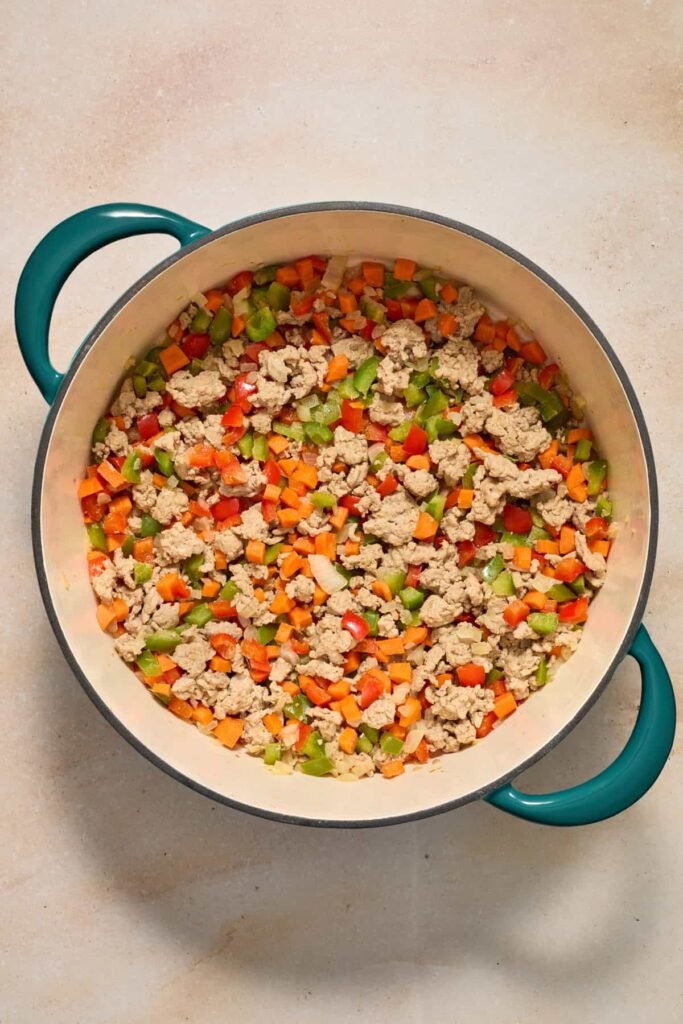
Dinner (480 cal): Ground turkey stir-fry — 5 oz lean ground turkey cooked with broccoli, snap peas, bell peppers, garlic, and ginger. Splash of low-sodium tamari. Serve over ½ cup of brown rice. ~38g protein
Snack (130 cal): Celery sticks with 1½ tbsp almond butter. ~5g protein
Day 2 totals: ~1,410 cal | ~101g protein
Day 3 — Wednesday: Midweek, Minimal Effort
Breakfast (340 cal): Overnight oats — mix ½ cup rolled oats, ½ cup unsweetened almond milk, 1 scoop vanilla protein powder, 1 tbsp flaxseed, and half a sliced banana in a jar the night before. Grab it from the fridge on your way out. ~30g protein
Lunch (430 cal): Lentil and vegetable soup — homemade if you meal prepped Sunday, good-quality low-sodium canned if you didn’t — with a thick slice of whole grain sourdough. ~22g protein
Dinner (500 cal): Baked chicken thigh (one bone-in, skin removed) with ½ medium roasted sweet potato and steamed green beans with a squeeze of lemon. Everything in the oven at 400°F for 35 minutes. That’s it. ~40g protein
Snack (150 cal): 1 cup cottage cheese with a few cherry tomatoes. ~14g protein
Day 3 totals: ~1,420 cal | ~106g protein
Day 4 — Thursday: Light and Genuinely Satisfying
Breakfast (320 cal): Green smoothie — 1 scoop vanilla protein powder, 1 cup frozen spinach, ½ frozen banana, ½ cup frozen mango, 1 cup unsweetened almond milk, 1 tsp fresh or powdered ginger. Blend until smooth. You won’t taste the spinach, I promise. ~28g protein
Lunch (450 cal): Tuna nicoise bowl — 4 oz canned tuna (in water, drained), 1 hard-boiled egg, cherry tomatoes, steamed green beans, a few kalamata olives, over mixed greens with a Dijon vinaigrette. ~40g protein
Dinner (460 cal): Shrimp and zucchini noodles — 5 oz shrimp sautéed in olive oil with garlic, cherry tomatoes, and fresh basil, tossed over spiralized zucchini (or regular zucchini cut into ribbons with a peeler). ~38g protein
Snack (160 cal): 2 rice cakes with 1½ tbsp peanut butter. ~6g protein
Day 4 totals: ~1,390 cal | ~112g protein
Day 5 — Friday: Eat Something That Feels Like a Treat
Breakfast (400 cal): Avocado toast with eggs — 1 slice whole grain bread, ½ mashed avocado, 2 poached eggs, red pepper flakes, and everything bagel seasoning. A little lemon zest if you’re feeling it. ~20g protein
Lunch (380 cal): Chicken and black bean burrito bowl — 4 oz grilled chicken, ½ cup black beans, ¼ cup brown rice, salsa, lettuce, 2 tbsp plain Greek yogurt instead of sour cream. ~38g protein
Dinner (500 cal): Grass-fed beef burger — 4 oz lean patty, no bun — over a bed of arugula with roasted mushrooms and caramelized onions. Small side of oven-baked sweet potato wedges. ~32g protein
Snack (170 cal): 1 cup Greek yogurt with a handful of raspberries stirred in. ~15g protein
Day 5 totals: ~1,450 cal | ~105g protein
Day 6 — Saturday: The Day You Actually Have Time to Cook
Breakfast (420 cal): Protein pancakes — blend 2 eggs, 1 scoop protein powder, and ½ cup rolled oats together, pour into a pan like regular pancakes, cook in coconut oil spray. Top with fresh strawberries. They’re not IHOP pancakes, but they’re genuinely good. ~35g protein
Lunch (400 cal): Mediterranean chickpea salad — 1 cup chickpeas, diced cucumber, cherry tomatoes, kalamata olives, red onion, a little crumbled feta, dressed with lemon juice and olive oil. Make extra. You’ll want it tomorrow. ~18g protein

Dinner (530 cal): Baked cod (5 oz) with roasted cauliflower florets and a side of lentil pilaf — ½ cup lentils cooked with onion, garlic, and a heavy hand of cumin. Surprisingly comforting. ~45g protein
Snack (150 cal): 1 oz almonds and 1 small pear. ~6g protein
Day 6 totals: ~1,500 cal | ~104g protein
Day 7 — Sunday: Cook Once, Eat Well All Week
Breakfast (360 cal): Egg muffins — whisk together 3 eggs with chopped spinach, diced bell pepper, and turkey sausage crumbles. Pour into a greased muffin tin, bake at 375°F for 18 minutes. Make a full batch, and you’ve got breakfasts ready for Monday and Tuesday too. ~28g protein
Lunch (440 cal): Grain bowl — ½ cup quinoa, 4 oz grilled salmon, roasted beets, sliced cucumber, a handful of pumpkin seeds, arugula, and tahini-lemon dressing drizzled over everything. ~38g protein
Dinner (490 cal): One-pan roasted chicken breast (5 oz) with sweet potato, broccoli, and garlic cloves tossed in olive oil and herbs. Everything on one sheet pan into the oven at 425°F for 30 minutes. Minimal dishes. Maximum satisfaction. ~42g protein
Snack (140 cal): Protein shake — 1 scoop mixed with water or unsweetened almond milk. ~22g protein
Day 7 totals: ~1,430 cal | ~130g protein
While dinner’s in the oven, cook a double batch of quinoa, roast an extra tray of vegetables, and hard-boil four eggs. You’ve just set yourself up for a much easier Monday.
Full Grocery List — Print This Before You Shop

Proteins:
- Chicken breasts and bone-in thighs (skin removed before eating)
- Ground turkey, 93% lean
- Salmon fillets, wild-caught — 5 portions, roughly 5 oz each
- Cod fillets — 2 portions
- Shrimp, frozen, 1 lb bag
- Lean grass-fed ground beef, 4 oz (for Saturday)
- Canned tuna in water, 3 to 4 cans
- Eggs, 2 dozen
- Plain nonfat Greek yogurt, large tub
- Cottage cheese, low-fat
- Feta cheese, small block or pre-crumbled
- Vanilla protein powder
Produce:
- Spinach and mixed greens, large bags
- Arugula
- Broccoli, asparagus, green beans, snap peas
- Zucchini, 2 to 3
- Cauliflower, 1 head
- Sweet potatoes, 4 to 5 medium
- Cherry tomatoes, 2 pints
- Bell peppers, 3 to 4 mixed colors
- Cucumbers, 2
- Mushrooms, 1 lb
- Red onion and yellow onion
- Garlic, 1 head
- Beets, roasted and packaged works fine
- Blueberries, strawberries, raspberries — fresh or frozen
- Bananas, 3 to 4
- Apples, 2
- Pears, 1 to 2
- Frozen mango, 1 bag
- Avocados, 4 to 5
- Lemons and limes
- Fresh ginger root
Grains and Legumes:
- Rolled oats
- Quinoa
- Brown rice
- Whole-grain sourdough bread
- Whole-grain tortillas
- Rice cakes, plain or lightly salted
- Green or brown lentils, canned or dry
- Canned chickpeas
- Canned black beans
- Canned cannellini beans
Pantry and Fats:
- Extra virgin olive oil
- Almond butter and peanut butter
- Almonds and walnuts
- Pumpkin seeds, chia seeds, flaxseed, hemp seeds
- Kalamata olives
- Tahini
- Low-sodium tamari
- Dijon mustard
- Apple cider vinegar
- Coconut oil spray
- Everything bagel seasoning
- Cumin, turmeric, garlic powder, dill, cinnamon, red pepper flakes
- Black pepper (more than you think — use it generously)
- Low-sodium chicken and vegetable broth
Optional but Helpful:
- Raw honey
- Sesame oil
- Goat cheese or extra feta
- Balsamic glaze
- Herbal teas — chamomile, peppermint, or ginger
Common Mistakes Women Over 30 Make on a Calorie Deficit
These aren’t criticisms. They’re patterns that show up constantly, and being aware of them genuinely changes outcomes.
Not eating enough protein: This is the number one issue, by a wide margin. Most women on a calorie deficit eat somewhere around 60 to 80 grams of protein a day and wonder why they’re losing muscle as fast as fat, why they’re hungry all the time, and why their results plateau early. Protein is the foundation. Everything else is secondary.
Going too low on calories: I know it feels counterintuitive, but eating 900 or 1,000 calories a day doesn’t make you lose fat faster — it makes your metabolism slow down to match. Your body is very good at surviving. Eat the 1,400 to 1,600 calories. It works better.
Skipping meals to bank calories: Skipping breakfast so you can “save” those calories for dinner doesn’t work the way you’d hope. It usually leads to intense hunger by mid-afternoon, poor food choices, and a dinner that erases the whole day. Distribute your calories across meals. It’s more metabolically and hormonally appropriate.
Forgetting about liquid calories: The morning oat milk latte. The afternoon kombucha. The glass of wine with dinner three times a week. The sports drink after your workout has 200 calories in it. These add up to hundreds of calories a day, and most people don’t count them at all.
Only doing cardio and skipping strength training: Cardio burns calories during the session. Strength training changes your body composition long-term by building and preserving muscle, which keeps your resting metabolic rate elevated. After 30, this trade-off matters more than it used to. Try to get 2 to 3 resistance training sessions per week alongside this meal plan.
Measuring progress only by the scale: Your weight can fluctuate 2 to 5 pounds within a single day based on water retention, sodium, hormonal cycles, bowel movements, and other factors that have nothing to do with fat loss. Weighing yourself every morning and spiraling when the number goes up is a fast track to quitting. Weigh yourself once a week, same time, same conditions. Or don’t weigh yourself at all and track by how your clothes fit instead.
Treating this like a temporary fix: The 7 days in this plan are a starting point, not the destination. If your default is to “go on a diet, lose some weight, go back to normal,” you will get the same result you’ve always gotten. The goal is to gradually make these foods and these habits your norm.
How to Make This Actually Sustainable
Because if it’s not sustainable, none of the rest matters.
Build your default rotation: Research consistently shows that most people eat from a pool of about 10 to 15 meals on repeat. So instead of trying to follow a new meal plan every week, identify the meals from this guide that you actually liked, and just keep making those. Rotating through 6 or 7 real meals you enjoy is infinitely more sustainable than trying to be creative and varied every single day.
Prep strategically, not exhaustively: You don’t need to spend four hours on Sunday turning your kitchen into a meal prep operation. That’s overwhelming, it’s not fun, and it tends to fall apart by week three. What actually helps: cook a double batch of grains, roast one sheet pan of whatever vegetables you have, prep two or three proteins. That’s it. Thirty minutes, and you’ve removed the friction from your busiest days.
Plan for the social stuff: Dinner out on Thursday, your friend’s birthday, date night, the office lunch where the only option is pizza — these aren’t obstacles to your plan, they’re just life. Eat a high-protein meal before you go if you can. Make the best available choice at the restaurant without treating it like a moral decision. Move on. One meal isn’t the problem. What you do consistently over months is the only thing that actually matters.
Give yourself a non-scale victory to track: How’s your energy in the afternoon? Are you sleeping better? Has the 3 pm crash gotten better or worse? Are your clothes fitting differently around your waist? These markers often shift before the scale does, and they’re more honest indicators of what’s actually happening in your body.
Recalculate every 4 weeks: As your weight decreases, so does your TDEE. A 500-calorie deficit at 165 pounds isn’t the same 500-calorie deficit at 155 pounds. If progress has stalled for 3 weeks in a row, recalculate your TDEE and adjust your intake accordingly.
Sleep like it’s your job: I know this isn’t technically a nutrition tip, but poor sleep increases ghrelin (your hunger hormone), decreases leptin (your fullness hormone), elevates cortisol, and makes every aspect of eating, moving more, and making good decisions dramatically harder. If you’re sleeping 5 or 6 hours a night and wondering why this isn’t working, start there.
Affiliate Picks: Tools That Actually Make a Difference
These are products that genuinely support the habits this plan is built around. Not every product works for every person, but these come up again and again for a reason.
| Product | Why It Actually Helps | Approx. Price |
| MyFitnessPal Premium | Tracks calories, macros, and micronutrients with one of the largest food databases out there. The macro breakdown view alone is worth it. | ~$19.99 |
| Optimum Nutrition Gold Standard Whey | 24g of protein per scoop, low sugar, mixes cleanly, widely available. One of the most consistently reliable protein powders on the market. | ~$35–$45 for 2 lb |
| Bare Performance Nutrition Whey | Cleaner ingredient profile, very popular with women 30+, great flavors. Worth trying if ON Gold Standard isn’t your thing. | ~$45 for 2 lb |
| Digital Kitchen Food Scale | The single most reliable way to actually hit your calorie targets. Eyeballing portions is notoriously inaccurate. A scale removes all the guesswork. | ~$10–$15 |
| Ninja Foodi or Instant Pot | Makes batch-cooking grains, soups, and chicken fast enough to actually happen on a weeknight. The “I don’t have time to cook” barrier mostly disappears. | ~$80–$150 |
| Etekcity Smart Body Scale | Tracks weight, body fat percentage, and muscle mass, and syncs to most fitness apps. Useful for seeing body composition changes that the scale number alone misses. | ~$30–$40 |
| Hydro Flask or Large Water Bottle | Dehydration is frequently mistaken for hunger. A quality, visible water bottle increases actual daily water intake more than any amount of willpower. | ~$35–$45 |
Pricing is approximate and may vary by retailer. Always check current reviews before purchasing.
FAQ: Calorie Deficit Meal Plan for Women 30+
Q: How much weight can I realistically lose in one week on this plan?
A: Genuine, sustainable fat loss runs at about 0.5 to 1 pound per week on a moderate deficit. You might see a larger drop in the first week or two — often 2 to 3 pounds — because cutting processed foods and excess sodium reduces water retention quickly. That’s real, and it feels good, but it’s not all fat. After week two, expect the pace to slow, and know that slower doesn’t mean the plan stopped working. It means it’s working the right way.
Q: Do I have to track calories every single day forever?
A: No, and honestly, most people shouldn’t. Tracking in the beginning — particularly for the first 3 to 4 weeks — is incredibly valuable because it builds an accurate mental picture of what portion sizes actually look like and how many calories are in the foods you eat regularly. Most women who think they’re eating 1,500 calories are actually closer to 1,900. Once you’ve tracked long enough to internalize that knowledge, many people shift to a looser approach and still maintain their results. Think of tracking as a temporary education, not a permanent requirement.
Q: Can I do this plan if I’m also doing intermittent fasting?
A: Yes. Intermittent fasting is a timing preference, not a metabolic magic trick — it doesn’t change the fundamental calorie math. If eating within a compressed window (say, noon to 8pm) feels natural to you and helps you stay within your calorie target without feeling deprived, go for it. If it makes you ravenous and leads to overeating in your eating window, it’s not the right tool for your body. Neither approach is superior. Both work when applied consistently.
Q: I’m in perimenopause. Does this plan still work?
A: The core principles are sound for perimenopause, but a few adjustments help. Protein needs may be slightly higher — closer to 1 gram per pound of body weight — because muscle loss accelerates during the hormonal transition. Resistance training becomes even more important than it already was. And because estrogen fluctuations affect sleep, mood, and cortisol, you may need to be more intentional about stress management and sleep hygiene alongside the dietary changes. If fat loss feels unusually resistant despite consistent effort, it’s worth speaking with your doctor about whether hormonal factors are playing a significant role.
Q: What if I’m breastfeeding?
A: A calorie deficit is not appropriate during breastfeeding without specific guidance from your doctor or a registered dietitian. Breastfeeding increases your caloric needs by roughly 400 to 500 calories above maintenance to support milk production and nutrient delivery. Restricting calories in this context can affect both milk supply and your own energy levels significantly. Hold off on a deficit plan until you’re no longer nursing, or get personalized guidance from a healthcare provider who can design something appropriate for your specific situation.
Q: I travel a lot for work. How do I keep this going when I’m not home?
A: The short answer is: you don’t have to be perfect, you just have to be consistent enough. At restaurants, a few easy moves go a long way — order a protein and two vegetables, ask for dressings on the side, skip the bread basket, and choose water or sparkling water instead of alcohol. At airports, most terminal shops now carry Greek yogurt, hard-boiled eggs, nuts, and fruit. Pack a protein bar or shake powder in your bag for truly desperate situations. And if a travel day goes completely sideways, let it go and get back on track the next morning. The plan doesn’t require perfection. It requires consistency over time.
Q: What if I stop seeing results after a few weeks?
A: This is normal, and it has a specific cause. As you lose weight, your TDEE decreases because a smaller body burns fewer calories at rest. What started as a 450-calorie deficit might only be a 150-calorie deficit six weeks later. First step: recalculate your TDEE at your new weight and adjust your intake down by 50 to 100 calories. Second step: look at your protein intake — inadequate protein almost always contributes to early plateaus. Third step: assess your activity level. Adding strength training or simply walking more can close the gap without having to eat less. And fourth: make sure you’re actually tracking accurately. Most people get looser with their tracking over time and underestimate their intake without realizing it.
One Last Thing
I want to be straight with you about something. There are probably 400 other articles on the internet right now with titles very similar to this one. And a lot of them will promise you’ll lose 10 pounds in a week, or that some specific combination of foods will “hack” your metabolism, or that you just need the right mindset shift.
None of that is what I’ve tried to give you here. What I’ve tried to give you is accurate, specific, genuinely useful information about how your body works after 30 — and a meal plan that’s actually designed around that reality instead of ignoring it.
Will this be easy? Not every day. There will be a Wednesday when you’re exhausted and hungry, and someone brings donuts to the office, and you eat two and decide the whole thing is ruined. It’s not ruined. Start on Thursday morning.
The women I know who have actually made lasting changes to their weight and health in their 30s and 40s didn’t do it by finding a more extreme diet. They did it by finding an approach they could return to, over and over, even after the hard days. That’s what this is meant to be.
Start with Day 1. See how you feel after a week. Then keep going.
This article is for informational and educational purposes only. It is not a substitute for personalized advice from a registered dietitian, physician, or other qualified healthcare provider. If you have a health condition, take medication, or have a history of disordered eating, please consult a professional before significantly changing your diet.


Add Comment